
Home » Travel » Bhadraj Temple Trek from Dehradun: The Ultimate Guide

Bhadraj Temple Trek from Dehradun: The Ultimate Guide

bhadraj temple trek from dehradun ,bhadraj temple dehradun

While the crowds at Mussoorie’s Mall Road are busy hunting for the perfect souvenir, a different kind of magic is unfolding just 15 kilometers to the west. Here, the air is thinner, the silence is punctuated only by the call of the Himalayan whistling thrush, and the view offers something most hill stations can only dream of. If you are looking for the most rewarding bhadraj temple trek from dehradun, this is the journey that captures the high Himalayas and the sprawling plains of the Doon Valley in a single, breathless 360-degree sweep.

The Bhadraj Temple Dehradun is often whispered about among local hikers as the “perfect beginner’s gateway.” But don’t let the “beginner” tag fool you; this trail offers a geographical and spiritual richness that rivals some of the more grueling multi-day expeditions in Uttarakhand.

The Legend of the Little Badrinath

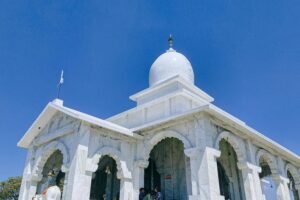
Before we talk about the dirt and the distance, we must talk about the spirit of the mountain. At the summit sits a modest, white-washed temple dedicated to Lord Balbhadra, the elder brother of Lord Krishna.

Local folklore suggests that after the great war of the Mahabharata, Lord Balbhadra sought a place of deep penance and serenity. He chose this ridge, overlooking the Yamuna and the Shivaliks. To this day, the bhadraj temple dehradun remains a site of immense faith for the Jaunsari community and the villagers of the Doon Valley. Every year, between August 15th and 17th, the quiet trail transforms during the Bhadraj Mela, where thousands of devotees trek up to offer milk and butter to the deity.


The Geography of the “Split Personality” Trail

What makes Bhadraj scientifically fascinating is its “Asymmetric Slope” phenomenon. As you trek along the ridge, you will notice a stark, almost surreal contrast:

1. The Northern Canopy:

The side facing the inner Himalayas is a lush, dark green world. It is a dense forest of Oak, Deodar, and ancient Rhododendrons. The air here is perpetually cool, and the ground is covered in a thick carpet of moss and fallen leaves.

2. The Southern Meadows:

Turn 180 degrees, and the forest vanishes. The southern slope, facing Dehradun, consists of vast, rolling yellow and green grasslands.

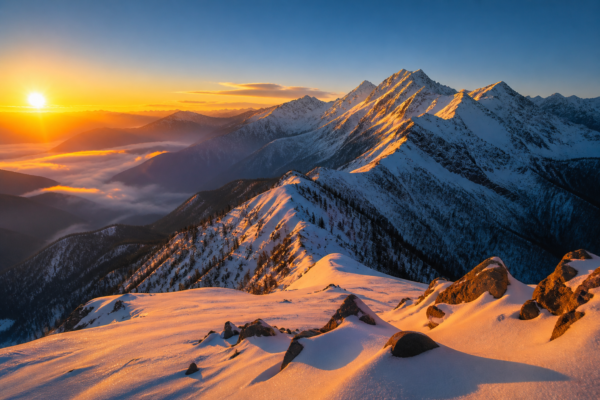
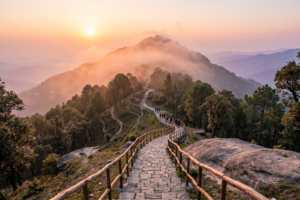
    Standing on the ridge line is like standing on the edge of two different climate zones. It is this unique geography that allows you to see the snow-clad peaks of Bandarpunch and Swargarohini on one side, and the winding Asan River and the lights of the city on the other.


    Trek Logistics: Breaking Down the Route

    To make your journey to the bhadraj temple dehradun successful, you must choose the route that fits your fitness level.

    Option A: The Classic Route (Cloud’s End)

    • Distance: ~13 km (Round trip)
    • Time: 6–8 hours
    • Experience: This is for the true hiker. You start at the historic Cloud’s End forest resort, an echo of the British era. The first 5 km are almost flat, winding through a deep forest. Once you reach the base of the Bhadraj hill, the real test begins with a steady, zig-zagging ascent that will test your calves but reward your eyes.

    Option B: The Shortcut (Dudhli Village)

    • Distance: ~5 km (Round trip)
    • Time: 3 hours
    • Experience: If you are short on time or hiking with children, drive your vehicle (preferably one with good ground clearance) up to Dudhli Village. From here, you skip the forest walk and jump straight into the climb. This route is favored by photographers who want to reach the summit specifically for the sunset “Golden Hour.”

    The “One Frame” Photography Guide

    To capture the Himalayas and the Doon Valley in one frame at the bhadraj temple dehradun, timing is everything.

    1. The Best Spot:

    About 200 meters before the final temple stairs, there is a flat, grassy knoll. This is the “Sweet Spot.”

    2. The Timing:

    The “Himalayan Haze” is real. If you go in the morning, the sun is behind the peaks, making them look washed out. The best time for photography is 3:30 PM to 5:30 PM. As the sun dips toward the Chakrata hills, it lights up the snow on the peaks with a fiery orange glow, while the valley below begins to turn a deep, twilight blue.

    3. Equipment:

    You don’t need a DSLR. A modern smartphone with an “Ultra-Wide” lens is actually better for capturing the scale of the ridge.


    Seasonal Wisdom: When to Go?

    1. The Winter (December–February):

    The air is crispest, and the Himalayas look close enough to touch. Expect light snow at the top of the bhadraj temple dehradun.

    2. The Monsoon (July–September):

    The “Green Season.” The meadows look like a lush wallpaper, but carry salt—the trail is notorious for leeches!

    3. The Spring (March–April):

    The Rhododendrons are in full bloom, turning the dark forest trails into a tunnel of crimson flowers.


    Preparation & Safety: The “No-Nonsense” Checklist

    A responsible blog post must include the “boring” but vital stuff.

    1. Hydration is Non-Negotiable:

    There are no shops and no water springs on this trail once you leave the base. You must carry at least 2.5 liters of water per person. Dehydration is the number one reason people fail to reach the Bhadraj summit.

    2. The “Leave No Trace” Rule:

    Because this is a religious site, the local community is very protective of its cleanliness. Do not leave plastic wrappers or bottles behind. As a blogger, you have the platform to advocate for Sustainable Trekking.

    3. Footwear:

    Wear shoes with “lugs” or deep treads; the final ascent of the bhadraj temple trek from dehradun is over loose gravel and can be slippery.

    4. Network Connectivity:

    Signal is patchy. Download an offline map of the area or use a GPS tracker, as some of the forest forks near Cloud’s End can be confusing.


      Why Bhadraj is the Future of Dehradun Tourism

      As Dehradun grows into a bustling city, the need for “Micro-Adventures” is skyrocketing. People don’t always have a week to go to Kedarkantha or Roopkund. They have a Sunday.

      The Bhadraj Temple Trek fits perfectly into the modern lifestyle. It offers the physical exertion of a workout, the peace of a pilgrimage, and the visual splendor of a high-altitude expedition—all within a 20 km radius of the city.

      By writing about this trail, you aren’t just sharing a map; you are sharing a secret. You are telling your readers that they don’t need to travel 200 kilometers to find the Himalayas. They just need to put on their boots, drive to the edge of the valley, and start walking.


      Final Thoughts for the Reader

      If you’ve lived in the Doon Valley your whole life and haven’t stood on the Bhadraj ridge, you haven’t truly seen your home. There is a specific kind of humility that comes from seeing how small the city looks from above, and how massive the mountains look from the front.

      Pack your bags, respect the trail, and don’t forget your camera. The “One Frame” view is waiting for you.

      Leave a Reply

      Your email address will not be published. Required fields are marked *